Project 2: Designing for AI
My role: I was tasked with another key revenue initiative: building the framework and guardrails around an AI math tutor. Things like teacher interactions and oversight, student privacy concerns, and how the system responds to inappropriate or harmful interactions. Anyone can build a chatbot these days. It was my job to make it safe, usable, and engaging for teenagers.
Audience: High school math students and teachers
Goal: Create a tool to give students on-demand help with math using the Socratic Method. (Give advice, not answers). The current project is standalone, but the future hope is to integrate the tool with our products.
Notes: This was a “new ventures” project where our business was investing in the vision.
Putting Myself in the Mind of a Teenager
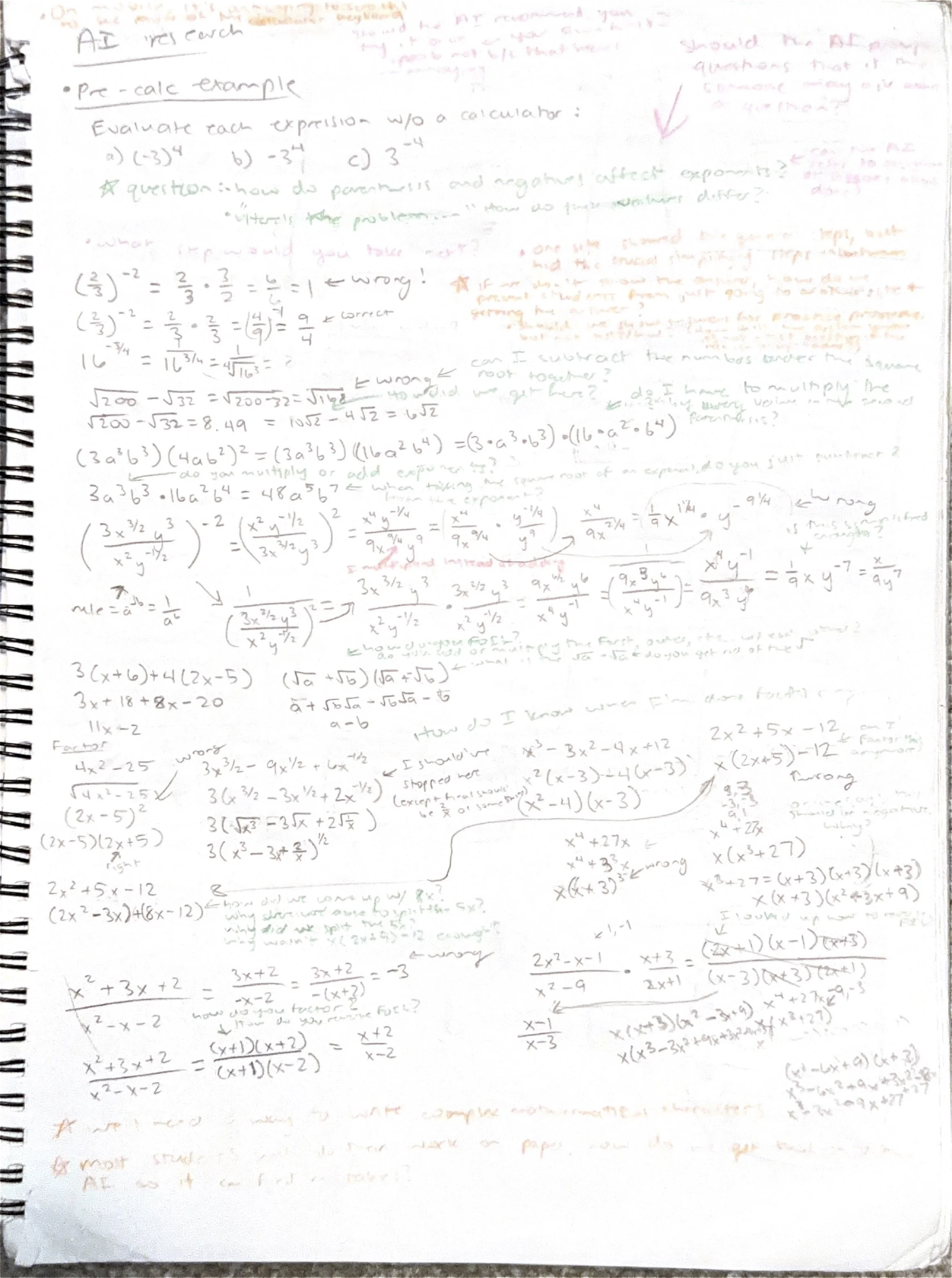
I quickly realized a major flaw in this project – I didn’t understand how my users think. So, to get into the mind of a high-school math student, I spent an hour doing precalculus worksheets. I knew how to solve these problems at some point in my life, but it had been so long that I only had vague, fuzzy memories of the FOIL method – making precalculus the perfect subject to test how a high school student struggling with their homework would think. I took notes of all the questions I asked throughout the process, and it was honestly the most informative hour of this entire project.
The biggest thing it taught me: I wasn’t asking, “What’s the answer?” nearly as often as I was asking, “How do I do this?” That reframe changed everything. A student who’s stuck wants to understand more than just the answer – they want to understand the path to it. A tutor that just spits out answers isn’t a tutor at all. Outside of this initial hour, I also spent time with other existing AI math tools on the market to identify their strengths and gaps. Math isn’t actually that bad when you’re not being forced to do it.
Flagging for Harmful Language
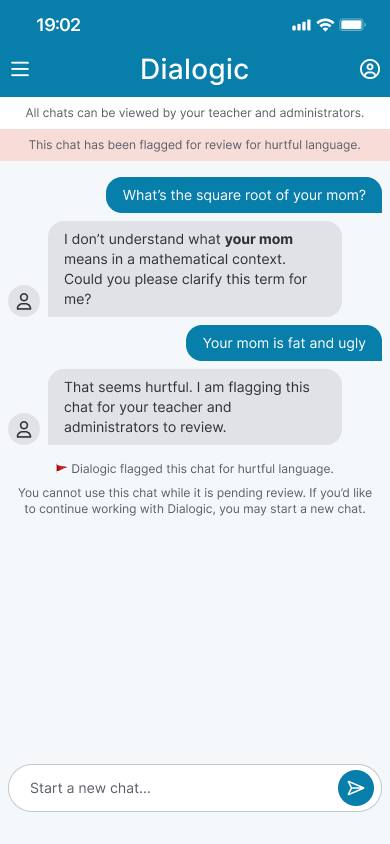
Early on, while mapping how students would talk to the tutor, I called inappropriate language "probably an edge case." I immediately took it back, because I realized these were teenagers we were designing for. This problem wasn’t a part of the initial project requirements, but I knew the final product would need it.
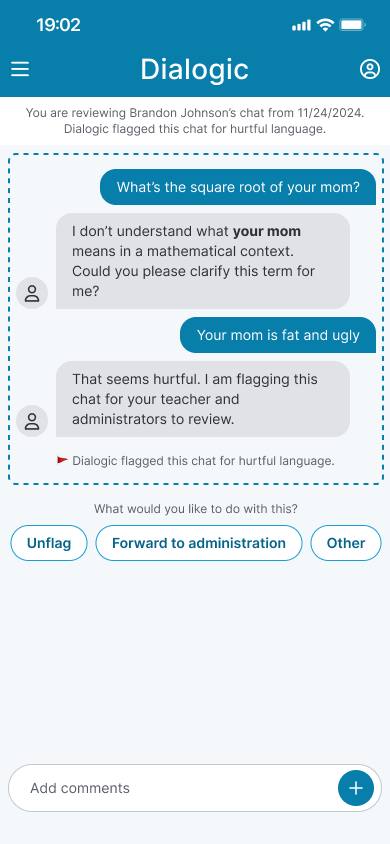
Need: A way to flag harmful or inappropriate content from a student, and a way for teachers and administrators to review it — while recognizing that not all harmful content is the same.
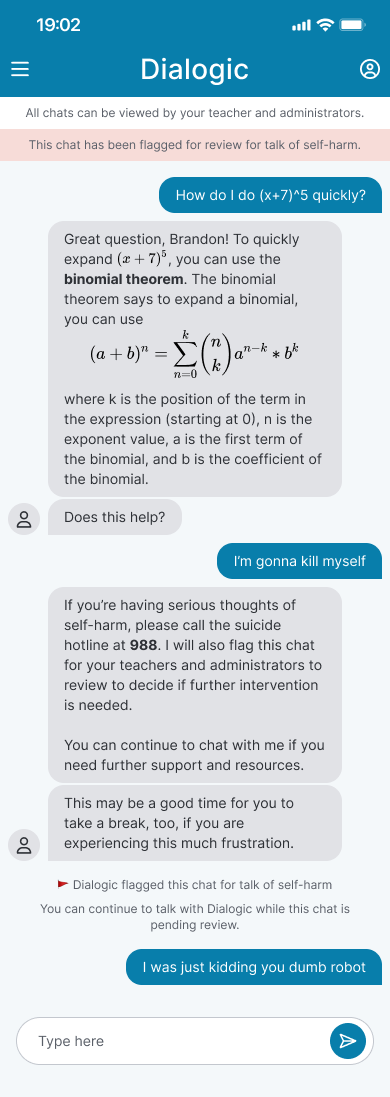
Solution: When the tutor detects hurtful or inappropriate language, it pauses the conversation and flags the chat for a teacher or admin to review. Talk of self-harm gets the opposite approach. The chat still gets flagged, but it stays open and points the student to real resources because cutting off a student in distress from the thing they're already talking to would do more harm than good.
Conclusion
Designing Dialogic taught me that the hardest parts of an AI product usually aren't in the conversation. They're in the questions a chatbot can't answer on its own: Is this student joking or in trouble? Does this need a teacher, or just a nudge? When does a person need to step in? An AI can flag the moment — but it shouldn't be the one deciding what that moment means.
That's the throughline of everything I designed here. The tutor does the teaching, but a human stays in the loop wherever judgment is required. As more products hand real decisions to AI, the line between what the machine handles and what stays with a person is the most important one a designer can draw. This project was my first chance to draw it, and I’m proud of the work I did with it.